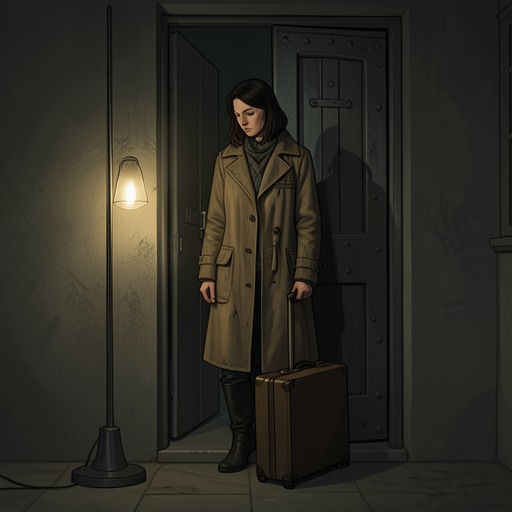
the two seascapes Connie bought from Blake McGrath
The light house: A love storyThe two seascapes Connie bought from Blake McGrath are not merely valuable paintings. They are the objects through which Connie Dixon recognizes that the supposedly vanished artist has continued to create, and they convert that recognition into freedom from Duncan Cartwright, financial security for her mother, and a renewed artistic future for Blake McGrath. Their movement from concealment to public significance parallels the novel’s movement from exploitation and grief toward disclosure, reciprocity, and redemption.
Discovery and Appearance
The paintings are shown to Connie Dixon by Warren Ryan after she has learned that Ryan’s grocery business has supplied an isolated artist for five years. He unwraps the bundle slowly, treating its contents as though they were priceless relics, while Connie rises like a worshipper approaching an altar. Her response is physical before it becomes commercial: her face loses its color, her eyes widen, and she cries when she sees the first canvas.
The first work is a small, unframed oil measuring only ten inches square, stretched over heavy wooden bars. It depicts two gulls on a barren beach beneath an outcrop of grey, craggy rock. Its compact size contrasts with the scale of its effect. Connie experiences it as more than a painted surface, sensing in its precision the wind and the sounds of the ebbing surf. The painting seems to preserve not only an image of the coast but the elements themselves, making artistic technique appear to cross into lived physical experience.
The second work is an unframed oil twice the length of the first. It shows a lonely beach and a small boat drawn up on the sand. Beside the boat stands the same beautiful young woman who appears in another seascape Connie has already encountered, her back turned enigmatically toward the artist and one hand extended toward an ocean that boils beneath a thunderous, slate-grey sky. The repeated figure connects the two paintings to a larger body of work while withholding her face; she is present as an image of longing, distance, and approach rather than as a fully disclosed identity.
Purchase and Authentication
Connie immediately understands that the paintings represent the rediscovery of greatness, but she initially has only one thousand dollars available. Ryan, under financial pressure and aware of the intensity of her desire, rejects that offer and counters with three thousand dollars for both paintings, in cash. The bargain is shaped by two kinds of vulnerability: Ryan needs enough money to satisfy the bank and survive the coming winter, while Connie feels that surrendering the paintings would mean losing something irreplaceable.
Connie therefore withdraws two thousand dollars from the joint nursing-home account maintained for her mother’s care, a decision that places her under immediate moral and financial strain. The bank warns her that a monthly payment to the nursing facility outside Exeter is due within a week and that insufficient funds would result in charges. She later admits the withdrawal to Jean, who reacts with horrified disbelief. The paintings thus enter Connie’s life through a compromised act of care: they are purchased at the cost of risking the very responsibility Duncan has used to control her.
The works acquire decisive authentication when Blake McGrath signs them. He carries both canvases into his studio, clears a space on a wide counter, and signs each lower corner with his trademark flourish. Because oil signatures would take a week or more to dry, he uses acrylic instead. He also writes personalized pencil inscriptions on the backs, addressing Connie as his good friend and retaining the original dates of composition rather than dating the inscriptions to the present. His explanation makes the paintings more than newly acquired art: they become direct, signed proof that Connie has found Blake and that the secluded artist remains connected to these works.
Leverage Against Duncan Cartwright
Connie uses the smaller painting as the first instrument of her break with Duncan Cartwright. During their confrontation, she slides the canvas across the table, and Duncan freezes when he recognizes what it implies. Connie tells him that she bought the last two available seascapes and offers him the first in exchange for a complete waiver of debts, responsibilities, and personal obligation. The painting becomes a counterforce to the arrangement through which Duncan had promised exhibitions, taken Connie to bed, and then kept her bound to him for four years without giving her the career he had promised.
When Duncan accepts the smaller work, Connie produces the second painting as a separate offer. She makes clear that it can be taken to another gallery the next morning if he refuses her terms. The larger seascape overwhelms even his resistance: he looks at it with the sensual intensity of a lover and feels compelled to own it at any price. Connie demands that two hundred and ninety thousand dollars be transferred into the account for her mother’s continuing care, along with five thousand five hundred dollars in cash. Duncan’s disbelief gives way to agreement when she reaches to reclaim the canvas. The painting’s market value therefore becomes the means by which Connie converts an intimate history of coercion into material independence.
The transaction reverses the old power relation. Duncan had insisted that Connie owed him for everything he had done for her; now he must pay to possess an object whose artistic authority exists independently of him. The first painting purchases her release from personal debts, while the second funds ongoing care and supplies immediate cash. Their division is significant: one work closes the emotional and sexual account between Connie and Duncan, while the other finances a future in which Connie can leave him.
Economic and Emotional Consequences
After the sale, Connie transfers forty thousand dollars of Duncan’s payment to Jean, leaving a quarter of a million dollars to cover their mother’s ongoing nursing-home costs. The burden that had confined Jean to a life of work and worry is lifted. The paintings consequently circulate through several economies at once: Ryan’s precarious business, Duncan’s possessive collecting, Connie’s struggle for autonomy, and the family’s need for long-term care. Their value is never purely aesthetic, even though Connie’s first response to them is an overwhelming recognition of beauty.
Connie also returns to Ryan to correct the original bargain. She explains that the three thousand dollars had been based on her initial impression of the paintings’ worth, before she understood their fair value, and offers him an additional forty thousand dollars. Ryan protests that the original price was fair and that both parties had accepted it, but Connie insists on paying more. This act distinguishes her from the exploitative logic surrounding her: once she gains power and knowledge, she chooses to repair the imbalance rather than preserve an advantageous ignorance.
The paintings remain tied to Blake’s private life as well as to the public art market. He has demanded that Connie tell no one where he lives, and the old dates on the inscriptions protect his privacy by concealing the moment at which she found him. The works are therefore simultaneously public commodities and guarded traces of a hidden existence. Their signatures reveal the artist, while their dates help preserve his isolation.
Afterlife and Significance
The paintings are carried out of their concealed context and into the future Connie builds in Hoyt Harbor. Their discovery leads to Connie’s return to the coast, her renewed connection with Blake, and the later exhibition in which his lost works are shown alongside a new portrait of Connie. Their presence in that exhibition helps make possible the opening of the Connie Dixon Gallery of Fine Art, where Blake can be publicly acknowledged without surrendering the private terms on which he has survived.
Their meaning also changes as Blake’s grief changes. He and Ned continue to go to the beach at sunset and send a rose into the sea for Chloe, while Ned waits through the night for her return. Blake’s art has been suspended by trauma, and the seascapes belong to the period before the full consequences of Chloe’s drowning have been spoken. Yet Connie’s arrival does not erase that grief. Like the paintings’ recurring shore, boat, storm-colored water, and turned-away figure, the works hold beauty and loss in the same frame.
At the exhibition, Blake says that he once believed going blind had ended his art career. He explains that he painted Connie’s portrait because he wanted redemption and announces that he will return to the easel, not to paint seascapes or portraits but to paint emotion. The two seascapes thus mark both the achievement from which he withdrew and the threshold beyond which he will move. They restore his name, but they do not define the limit of his future. Their deepest function is to make visible a passage from hidden talent and possessive exchange toward art as an ongoing means of feeling, remembrance, and renewal.